The Prime Minister's tourism plan: what's in it, and what's missing
Prime Minister Tarique Rahman may unveil Bangladesh's tourism master plan in December. Here is everything the government has announced on tourism in eight months — a new National Tourism Council, a tourism policy, new hotels and a training institute, a tourism satellite account — and where the gaps remain.
"Reading the Master Plan" is Bangladesh Traveller's weekly series on the country's first national tourism master plan. Each week we take one part of the plan: what it says, what it leaves out, and what should change.
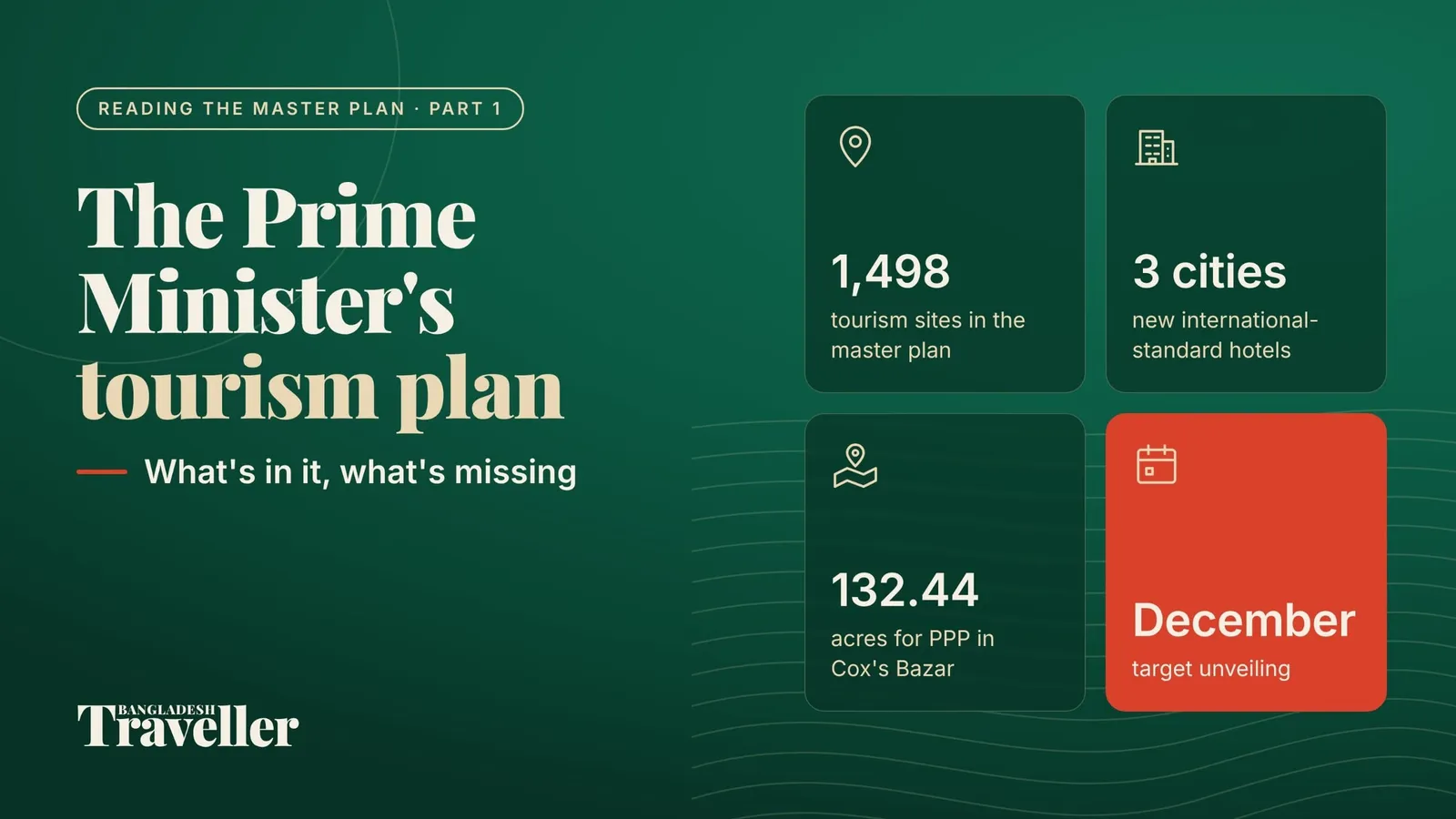
Prime Minister Tarique Rahman may unveil Bangladesh's first National Tourism Master Plan in December. Barrister Mutasim Billah Faruqui, chief executive of the Bangladesh Tourism Board (BTB), told BSS that the review committee is expected to return the revised plan by 30 November and that it will go to the ministry in the first week of December. If the National Tourism Council approves it, the plan is to unveil it at the proposed Bangladesh Festival in Dhaka (27–31 December), though the programme and the Prime Minister's attendance are not yet confirmed. "Our objective is to start implementing the activities outlined in the master plan from January," he said.
The full document has not been published. But what the Prime Minister has told parliament, and what ministers and officials have said at events over the past eight months, add up to a clear picture of the government's thinking on tourism. This part sets out that picture, and its strengths and weaknesses.
What the Prime Minister has said
Answering a question in parliament on 8 April, the Prime Minister called tourism "a key driver of economic growth" and said the government, in line with its election manifesto, is developing short-, medium- and long-term strategies. The main points:
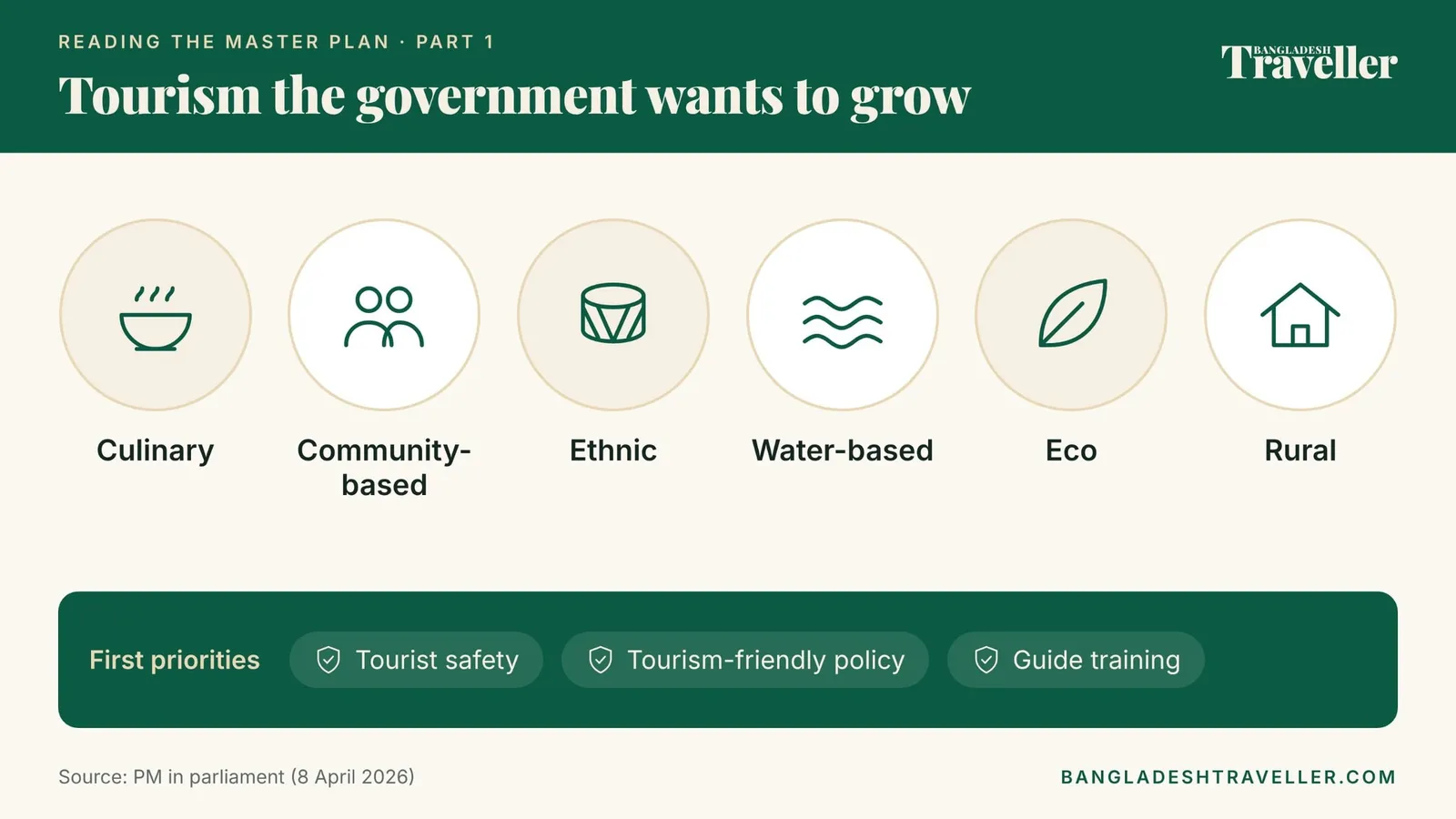
- Priorities: tourist safety, tourism-friendly policies and better training for tour guides.
- New kinds of tourism: culinary, community-based, ethnic, water-based, eco and rural tourism.
- Regional balance: notable attractions in more than 30 districts, with region-specific tourism built on local heritage and culture.
- The master plan: a 20-year roadmap covering tourism laws and regulations, tourism clusters, cultural heritage, infrastructure, expansion of coastal tourism, and environmental measures such as protecting biodiversity and cutting carbon emissions.
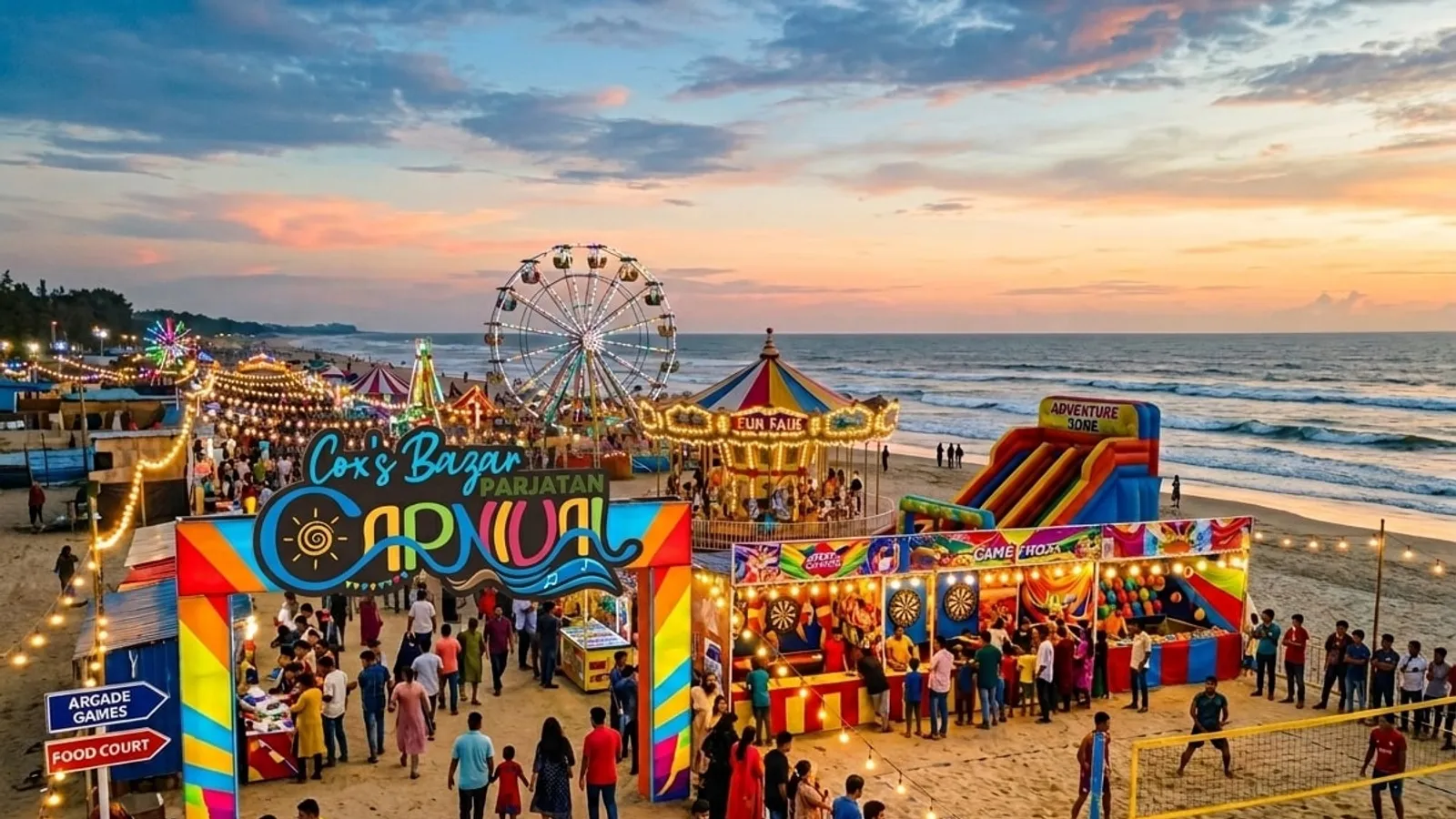
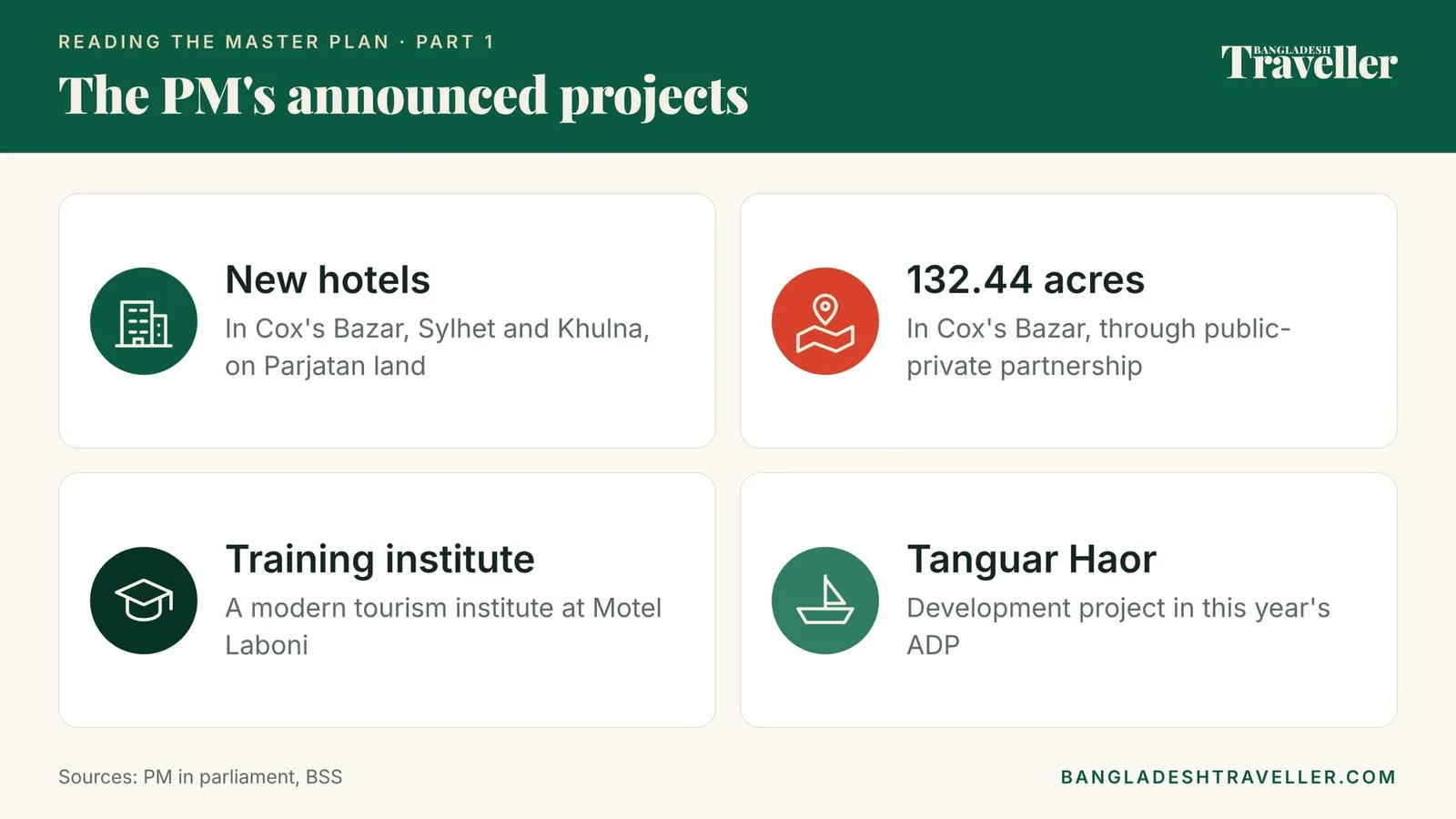
The Prime Minister later told parliament of specific projects: international-standard hotels and facilities on Bangladesh Parjatan Corporation land in Cox's Bazar, Sylhet and Khulna; 132.44 acres in Cox's Bazar earmarked for public-private partnership; and a modern tourism training institute at the Motel Laboni compound.
Eight months of announcements
| When | What |
|---|---|
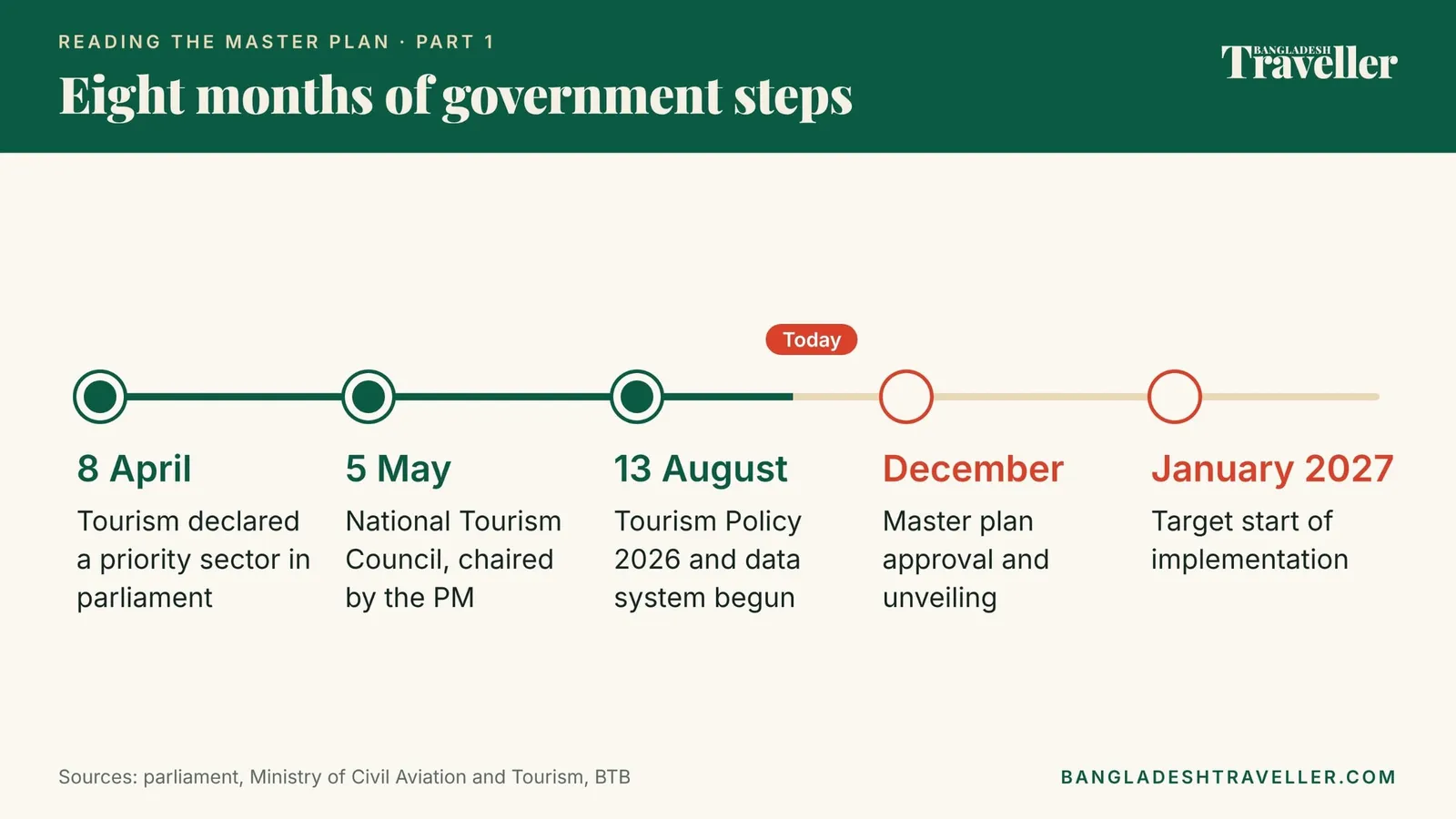
| 8 April | PM in parliament: tourism a priority sector, a 20-year master plan is coming |
| 4–5 May | National Tourism Council reconstituted by gazette with the PM as chair; goal to double tourism's share of GDP announced at the deputy commissioners' conference |
| 13 August | Work begins on a National Tourism Policy 2026 and a tourism satellite account; Tanguar Haor development project included in this year's ADP |
| 17 September | Integrated master plan covering 1,498 sites announced at the Asian Tourism Fair; plan to make Cox's Bazar a regional tourism hub |
| 28 September | Domestic flights move to the new international terminal at Cox's Bazar airport |
| 30 November | Revised master plan due back to the BTB |
| December | Submission to the ministry, council approval, possible unveiling (27–31 December) |
| January 2027 | Target start of implementation |
At a BTB seminar in August, State Minister M Rashiduzzaman Millat added that ministries would sign memoranda of understanding to close coordination gaps, that staffing at the BTB and the Tourist Police would be increased, and that the Prime Minister would be asked to convene the National Tourism Council every six months. Ministry secretary Fahmida Akhter said work had started on a tourism satellite account to fix the lack of reliable tourism data. In May, Minister Afroza Khanam spoke of developing heritage sites such as Baliati Palace and the Teota Zamindar House.
Where the master plan comes from
The master plan is not being written from scratch. Work began in 2019; the Indian consultancy IPE Global prepared the draft for Tk 28.66 crore and finished it in June 2023. It was never approved, and under the interim government it went back for review. The current government is revising that draft and adding its own priorities. Our detailed analysis of the draft's targets, numbers and projects will follow in later parts of this series.
Analysis: where the government is on the right track
- Ownership at the top: the Prime Minister chairs the National Tourism Council and has called tourism a priority sector in parliament. In a sector that touches more than 30 ministries, coordination is impossible without leadership from the top.
- Admitting the data problem: starting a tourism satellite account is an important step. There is still no reliable answer to basic questions: how many tourists, how much income, how many jobs.
- A focus on domestic and rural tourism: community-based, rural, water-based and culinary tourism fit the reality that around 90% of tourists in Bangladesh are domestic, and their benefits reach local people more easily.
- Putting the private sector at the centre: offering unused Parjatan Corporation land through PPP is a realistic route.
Analysis: where questions remain
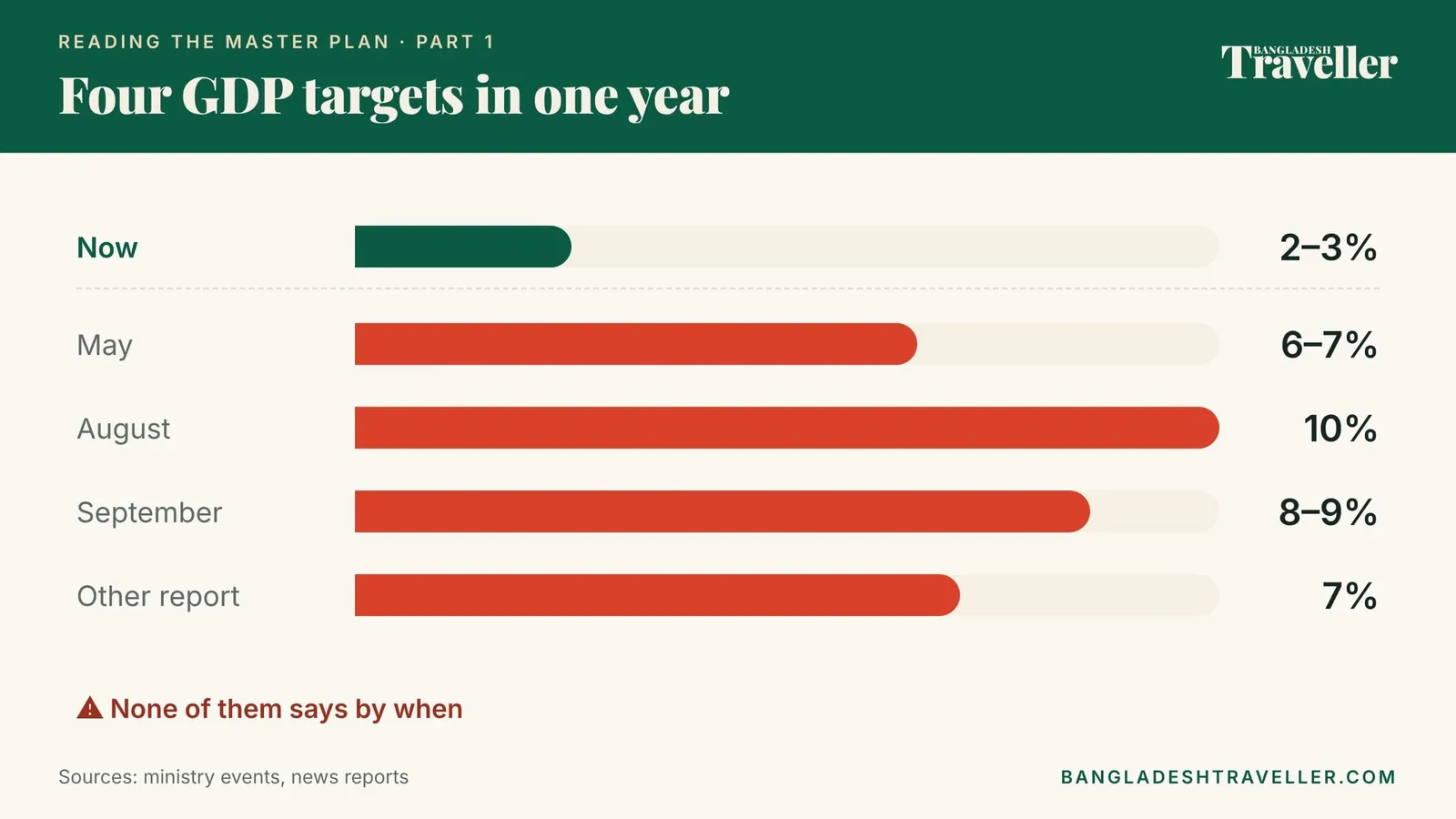
- No single target: the ministry has given four different targets for tourism's share of GDP this year: 6–7% in May, 10% "in the foreseeable future" in August, 8–9% in September, and 7% in another report. The current share is 2–3%. Without one target and a date, progress cannot be measured.
- No budget: no statement has said how much public money will go to the announced hotels, training institute or clusters. Apart from Tanguar Haor, it is not known whether any project is in the ADP.
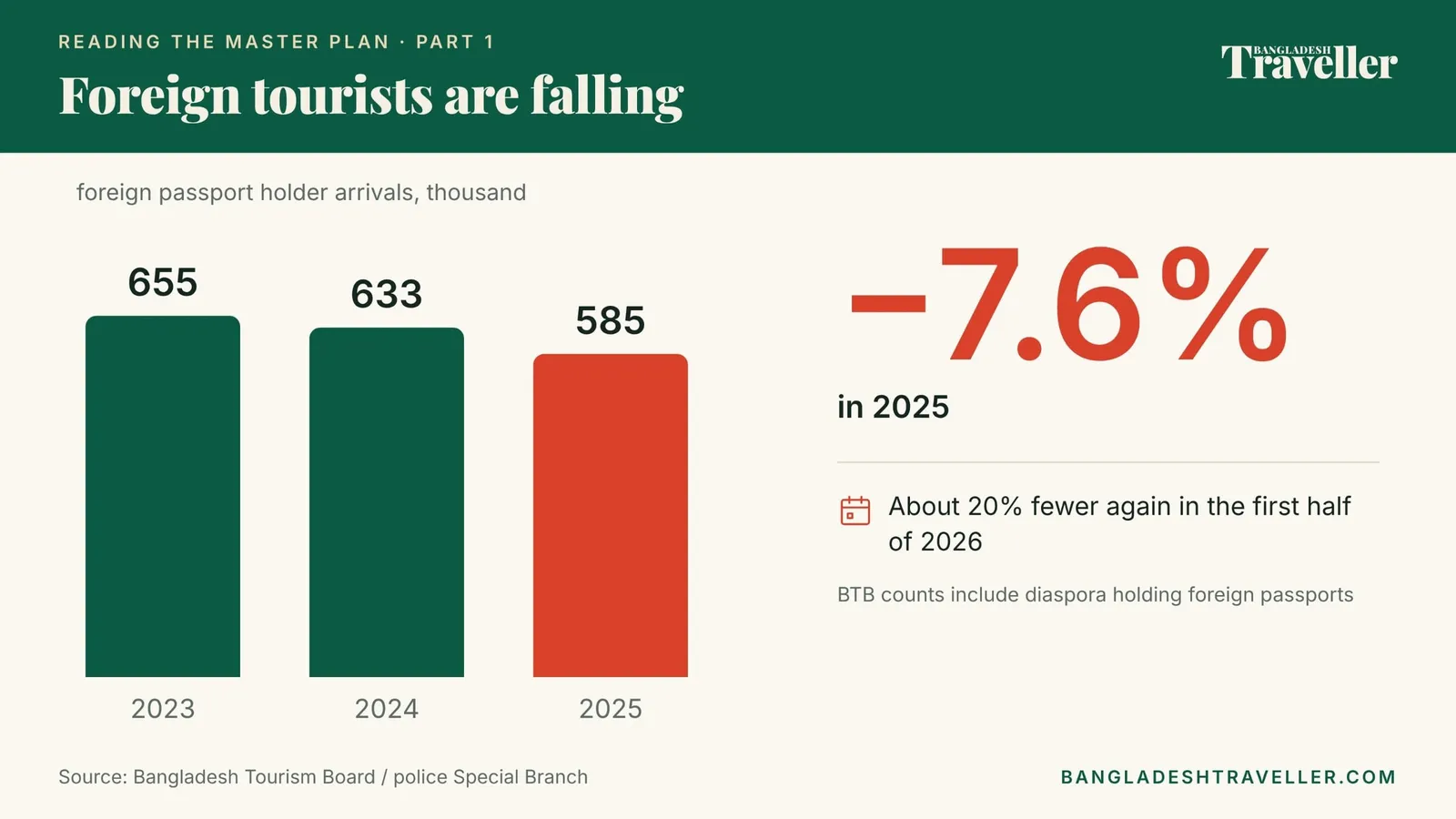
- Foreign arrivals are falling: BTB data show foreign passport holder arrivals of 655,451 in 2023, 633,094 in 2024 and 585,145 in 2025, and about 20% fewer in the first half of 2026 than a year earlier. Arrivals from India fell by a third in two years. No immediate measure to reverse the decline has been announced.
- Still no e-visa: e-visas were described as "in the final stages" in 2023. The government's statements mention tourist safety, but there is no deadline for making entry easier.
- A closed review: what is changing in the old draft, who sits on the review committee, and whether industry stakeholders are being consulted have not been made public. If review, approval and unveiling all happen within a few weeks, there is little time to check the details.
- Environmental limits: Tanguar Haor is a Ramsar site; Saint Martin's Island, the Sundarbans and Sajek are also fragile. Alongside development, no policy has yet been announced on how many visitors each place can sustain.
What to watch in December
- The full document published in Bangla and English on the day it is unveiled, so investors and researchers can check it.
- One target, one deadline: annual targets for GDP share, tourist numbers and jobs.
- The first 100 days: launching e-visas, airport tourist help desks, and the first tourism satellite account report.
- The money: allocations for the first projects in the revised budget.
- Regular council meetings: whether the National Tourism Council meets every six months and reports progress publicly.
The bottom line
The government's tourism thinking has a direction: leadership from the top, fixing the data, domestic and rural tourism, and private investment. What it still lacks are yardsticks: a specific target, a budget and a timetable. Bangladesh has rarely lacked master plans; it has lacked implementation. Whether December's unveiling breaks that pattern will be clear in the first six months after January.
Next week: the draft's 2041 targets — do the numbers behind 5.58 million tourists add up?
FAQ
When will the tourism master plan be unveiled?
According to the BTB, the Prime Minister may unveil it in December once the National Tourism Council approves it, possibly at the proposed Bangladesh Festival on 27–31 December. The date is not final. Implementation is targeted to start in January 2027.
Which tourism projects has the government announced?
International-standard hotels on Parjatan Corporation land in Cox's Bazar, Sylhet and Khulna; 132.44 acres in Cox's Bazar for development through PPP; a modern tourism training institute at the Motel Laboni compound; and a Tanguar Haor development project in the ADP.
What is the National Tourism Council?
The highest policy body for tourism. It was reconstituted in May 2026 with Prime Minister Tarique Rahman as chair. It sets policy, coordinates ministries, attracts investment and oversees development plans.
Is the master plan new?
Not entirely. A BTB committee is reviewing the draft begun in 2019 and completed in 2023; a revised version with the current government's priorities is due in December.
Sources
- Kaler Kantho: PM may unveil tourism master plan in December (13 November 2026)
- The Report / BSS: PM likely to unveil tourism master plan next month (13 November 2026)
- The Bangladesh Monitor: PM unveils country's tourism strengthening strategy (8 April 2026)
- The Bangladesh Monitor: Govt sets up National Tourism Council to drive sector growth (5 May 2026)
- The Bangladesh Monitor: Govt aims to double tourism's contribution to GDP (5 May 2026)
- The Financial Express: Govt formulating National Tourism Policy 2026 (13 August 2026)
- Daily Waadaa: Tourism master plan underway covering 1,498 attractions nationwide (17 September 2026)
- bdnews24.com: Cox's Bazar airport's new terminal (27 September 2026)
- The New Nation: Foreign arrivals slide in 2025 (September 2026)
- The Daily Star: Bangladesh sees gradual decline in foreign tourist arrivals (September 2026)
- The Business Standard: Six-year-old tourism masterplan stuck in review, changes on the way (September 2025)